
Assistive, with sign-off
Clinical
OxRad drafts the report. A qualified radiologist reviews, edits, and signs. The clinician stays in the loop, always.

Is OxRad an autonomous diagnostic device?
No. OxRad is assistive reporting with a clinician in the loop. It produces a draft report on-site; a qualified radiologist reviews, edits where needed, and signs. OxRad never signs and never issues a diagnosis on its own. The human sign-off is part of the design, not a disclaimer.
How sign-off works
OxRad produces the draft. A qualified radiologist reviews, edits, and signs. The human is the gate, not a rubber stamp.
- 01
OxRad Intelligence drafts the report.
- 02
The radiologist reviews and edits.
- 03
The radiologist signs.
- 04
OxRad never signs.
The lead investigator and the radiologist team
Dr Gurinder Singh Bholla
Lead Investigator · MD Radiodiagnosis · MBBS · 25+ years in diagnostic imaging
OxRad is led clinically by Dr Bholla, a consultant radiologist and director of a diagnostic-imaging company who brings more than two decades of reporting experience to the work.
He works with a team of practising radiologists who shape OxRad alongside him: the clinical requirements, the reporting conventions, and the sign-off workflow are set by people who read studies for a living, and drafted reports are reviewed against their day-to-day standards as testing progresses.
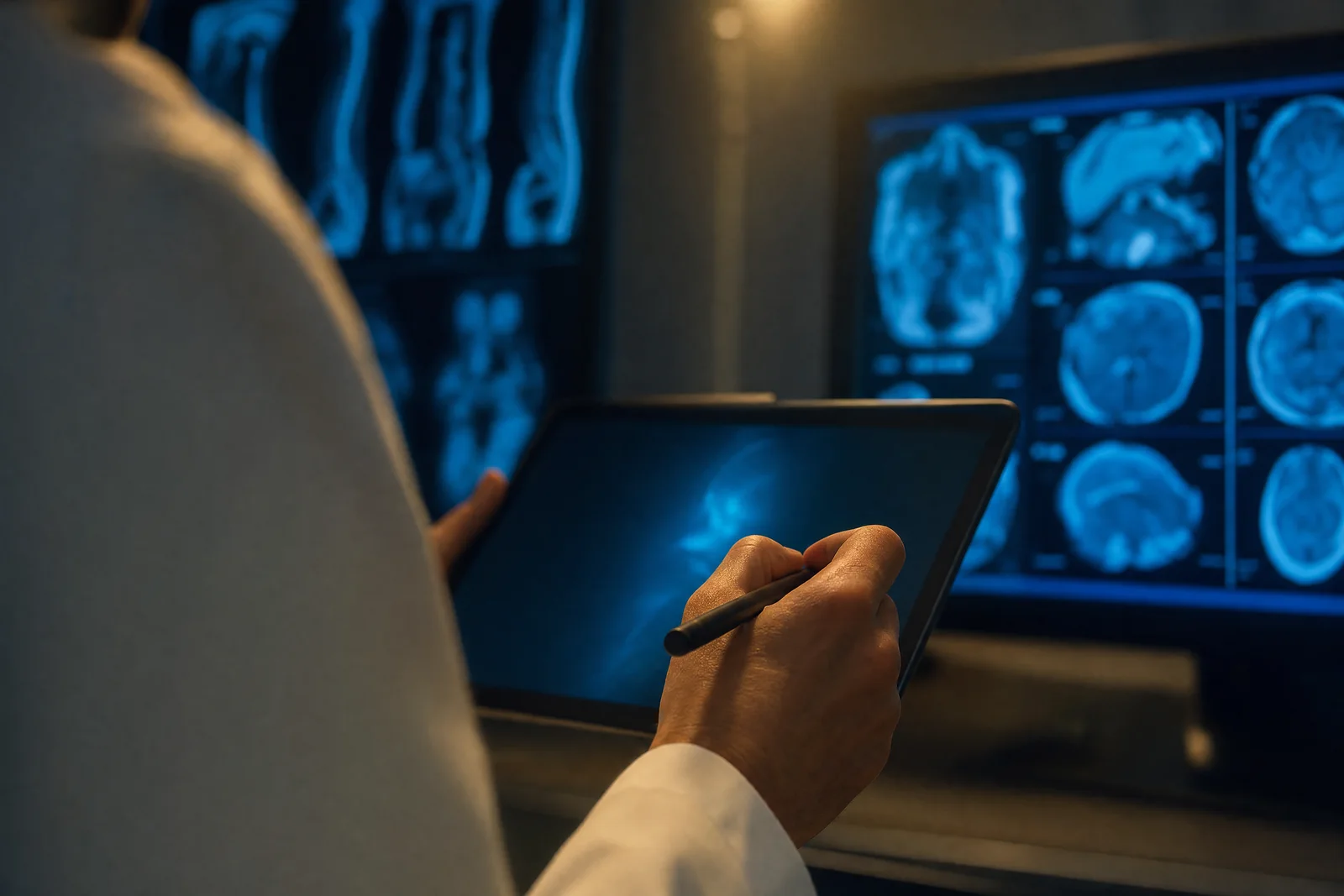
Where the clinical work stands today
The OxRad system is built and in active testing. We are stress-testing the platform now, ahead of clinical evaluation with a partner diagnostic-imaging centre. We describe this honestly: it is a validation plan, not a results page.
We publish no clinical outcome metrics, accuracy figures, or testimonials, because none exist yet. When evaluation produces evidence worth reporting, we will report it with its method and its limits. Until then, the architecture is what we can show, and the Build Paper documents it in full.
How OxRad will be validated
Validation follows the assistive framing. The question is not whether a model can replace a radiologist, but whether a locally drafted report helps a radiologist work faster and more consistently while they remain fully responsible for the signed result.
The evaluation will run on-site, with a clinician reviewing and signing every report, and with the OxChain audit recording the process. Methods and findings will be set out plainly once the work is done.
Read studies and want private, on-site AI reporting?
We are taking a small number of clinical pilot partners.